Future Homes, Future Thinking | KeyHouse Interview
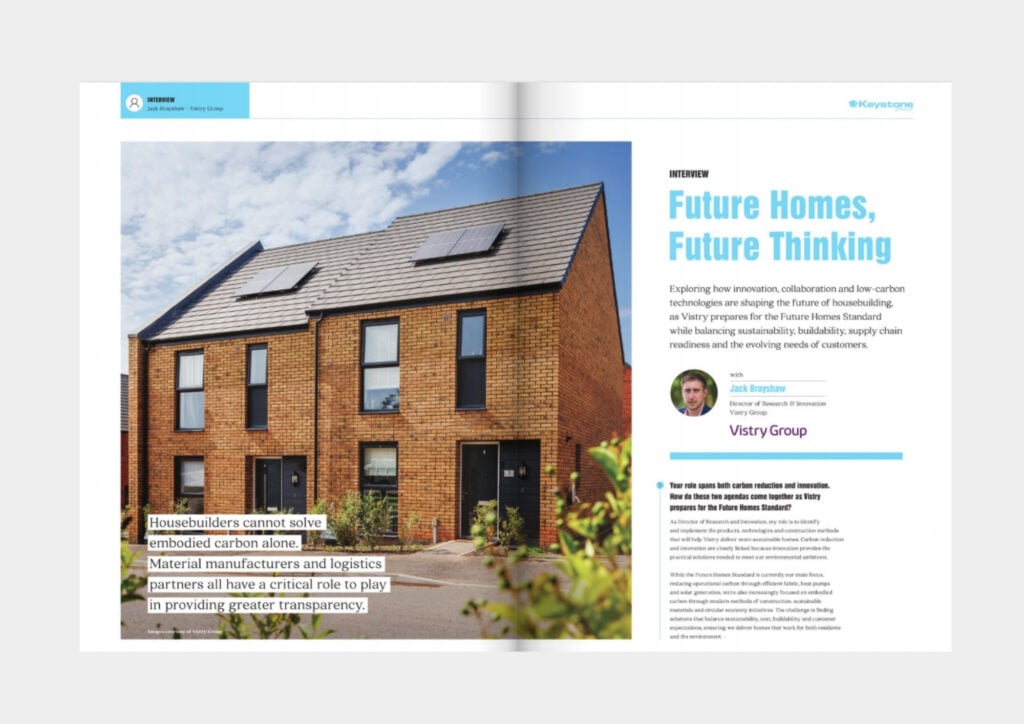
Exploring how innovation, collaboration and low-carbon technologies are shaping the future of housebuilding, as Vistry prepares for the Future Homes Standard while balancing sustainability, buildability, supply chain readiness and the evolving needs of customers.
With Jack Brayshaw, Director of Research & Innovation, Vistry Group
Your role spans both carbon reduction and innovation. How do these two agendas come together as Vistry prepares for the Future Homes Standard?
As Director of Research and Innovation, my role is to identify and implement the products, technologies and construction methods that will help Vistry deliver more sustainable homes. Carbon reduction and innovation are closely linked because innovation provides the practical solutions needed to meet our environmental ambitions.
While the Future Homes Standard is currently our main focus, reducing operational carbon through efficient fabric, heat pumps and solar generation, we’re also increasingly focused on embodied carbon through modern methods of construction, sustainable materials and circular economy initiatives. The challenge is finding solutions that balance sustainability, cost, buildability and customer expectations, ensuring we deliver homes that work for both residents and the environment.
Much attention has been given to operational carbon in homes. As energy performance improves, how is the industry’s focus shifting towards embodied carbon?
Over the last decade, the industry’s primary focus has been reducing operational carbon, the emissions associated with heating, cooling and powering homes. The Future Homes Standard will accelerate that transition further, with highly efficient building fabric, low-carbon heating systems and renewable technologies significantly reducing emissions in use.
As operational carbon continues to fall, embodied carbon will become a much larger proportion of a home’s overall environmental impact.
Embodied carbon relates to the emissions created through the extraction of raw materials, manufacturing products, transporting them to site, construction, maintenance and ultimately end-of-life disposal. We now need to consider a home’s whole-life carbon footprint rather than focusing solely on how much energy it consumes once occupied.
This means collaboration across the supply chain is becoming more important than ever. Housebuilders cannot solve embodied carbon alone. Material manufacturers and logistics partners all have a critical role to play in providing greater transparency around the carbon impact of their products and identifying opportunities to reduce emissions throughout the value chain.
At Vistry, we’re already exploring this through modern methods of construction, timber frame manufacturing, circular economy initiatives and research into design for disassembly and material reuse. Projects such as our Innovate UK-funded VIC-E deconstruction programme are helping us better understand where carbon is generated across a building’s lifecycle and how those impacts can be reduced in the future.
In the short term, our priority remains successfully implementing the Future Homes Standard. However, once the industry establishes the right low-carbon operational specifications, I expect embodied carbon and whole-life carbon assessment to become one of the next major frontiers for housebuilding. The challenge will be identifying solutions that reduce emissions while remaining commercially viable, scalable and practical to deliver at volume.
Developing a Future Homes Standard-compliant specification is clearly a complex process. What has Vistry’s journey involved so far, and what lessons have been learned along the way?
Preparing for the Future Homes Standard is a significant technical exercise for the business. Rather than looking for a single solution, we’ve taken a structured approach, working with our energy assessors and internal teams to evaluate a wide range of specification options across both masonry and timber frame construction. This has involved modelling combinations of fabric improvements, heating technologies, ventilation systems and renewable energy solutions to understand both compliance and practical delivery considerations.
One of the key lessons has been that achieving compliance is only part of the challenge. A specification may perform well in a model, but it also needs to be commercially viable, buildable at scale, supported by the supply chain and deliver a positive experience for customers. As a result, we’ve assessed potential solutions through a wide range of lenses, including technical performance, procurement, construction, commercial impact and customer outcomes.
Perhaps the biggest lesson has been the importance of evidence-based decision making. We have worked closely with assessors, manufacturers, industry bodies and our regional teams to ensure decisions are informed by data, testing and real-world experience rather than assumptions.
One of the biggest lessons has been the importance of balancing innovation with buildability and customer experience. New technologies can offer significant benefits, but they must be easy for our teams to install, straightforward for customers to understand and capable of delivering reliable long-term performance. Innovation only succeeds when it works in the real world, not just in a specification document.
The Future Homes Standard places significant emphasis on low-carbon technologies. Have there been any findings or requirements that have surprised you during the process?
One of the most significant findings has been the extent to which solar PV has become central to Part L 2026 compliance. While the industry expected improvements in fabric performance and wider adoption of heat pumps, the level of reliance on solar generation has perhaps been greater than many anticipated, as it has become a functional requirement outside of Standard Assessment Procedure (SAP) / Home Energy Model (HEM).
Roof design and orientation, for example, can have a significant influence on the effectiveness of solar panels. Not every home has an ideal south-facing roof, and factors such as roof geometry, neighbouring buildings, shading, planning requirements and architectural design can all affect performance.
The process has also reinforced that delivering low-carbon homes is about more than meeting an energy target on paper. There are practical considerations around installation, supply chain capacity, customer experience and the interaction between technologies. As specifications become more dependent on electrification and renewable generation, there is also increasing consideration of wider infrastructure requirements and the ability of local networks to support these solutions.
Overall, the biggest surprise has not been the technologies themselves, but the extent to which successful delivery depends on resolving a wide range of practical considerations around design, infrastructure, supply chains and implementation. It reinforces why early planning and collaboration across the industry are so important as we move towards full adoption of the Future Homes Standard.
Achieving compliance is about far more than selecting individual products. How important is collaboration across the business and supply chain in delivering the right solution?
The Future Homes Standard is often discussed in terms of technologies such as heat pumps, solar panels or enhanced fabric specifications, but in reality compliance is about delivering a complete solution that works from design through to occupation. No single team or supplier can achieve that alone.
Ultimately, delivering the right Future Homes Standard solution is a cross-functional exercise. The best outcomes are achieved when technical performance, commercial viability, operational delivery and customer needs are considered together. That collaborative approach has been fundamental to the progress we’ve made so far and will remain essential as we move towards implementation.
As the industry moves towards greater adoption of technologies such as heat pumps, solar PV and advanced fabric solutions, ensuring sufficient capacity and resilience within the supply chain becomes a key part of successful implementation.